

How Often Should You Mow a Lawn in Schertz, TX?
For many lawns, weekly mowing works well during periods of active growth. If the grass is growing more slowly and remains manageable between visits, mowing every two weeks may be enough.
A calendar can provide a useful starting point, but the lawn should ultimately determine the schedule. If grass is getting noticeably tall or the lawn looks overgrown before the next planned visit, the interval is probably too long.
On the other hand, mowing more often than the lawn needs does not necessarily provide a benefit. What matters is maintaining a reasonable amount of growth between cuts and avoiding the need to remove a large amount of grass at once.
Weekly vs. Bi-Weekly Lawn Mowing
| Mowing schedule | When it may make sense | What to watch for |
| Weekly | Faster growth and regular maintenance | Avoid cutting more than the lawn needs |
| Bi-weekly | Slower growth or lawns that stay manageable longer | Grass may become too tall between visits |
| Less frequent | Limited-growth periods or occasional maintenance | Greater risk of overgrown grass |
Neither weekly nor bi-weekly mowing is automatically the better choice. A lawn that grows quickly may need regular weekly attention, while another property may remain manageable for longer between cuts.
If grass consistently becomes too tall before the next mowing, extending the interval is probably not working for that lawn.
How the Seasons Can Change Your Mowing Schedule
Grass does not grow at the same rate throughout the year, so your mowing routine may need to change with it.
Spring
As growth picks up, mowing may become more frequent. A lawn that needed less attention during a slower-growth period can quickly outgrow that schedule once active growth begins.
Summer
Summer mowing needs can vary. Rainfall, irrigation, heat, and the lawn’s actual growth rate all play a role. Some lawns may continue growing quickly, while others may not need the same frequency.
Rather than switching to a fixed summer schedule, pay attention to how quickly the grass is growing.
Fall
As growth slows, the time between mowing visits may increase. If the lawn remains at a manageable height for longer, there may be less reason to mow as frequently as during periods of faster growth.
Winter
Grass growth slows during winter, so the time between mowing visits can increase. If the lawn continues growing, keep mowing as needed to maintain a manageable height.
How Rainfall and Irrigation Affect Mowing Frequency
Water availability can affect how quickly grass grows. Rainfall may encourage more growth when other conditions are suitable, and irrigation can also influence the lawn’s growth rate.
That means two lawns in the same area may not need exactly the same mowing schedule. One may receive more water and grow faster, while another may remain manageable for longer.
Instead of assuming that more rain automatically means weekly mowing, look at the lawn itself.
Watch the lawn’s growth rather than relying only on the calendar.
Signs Your Lawn Needs Mowing
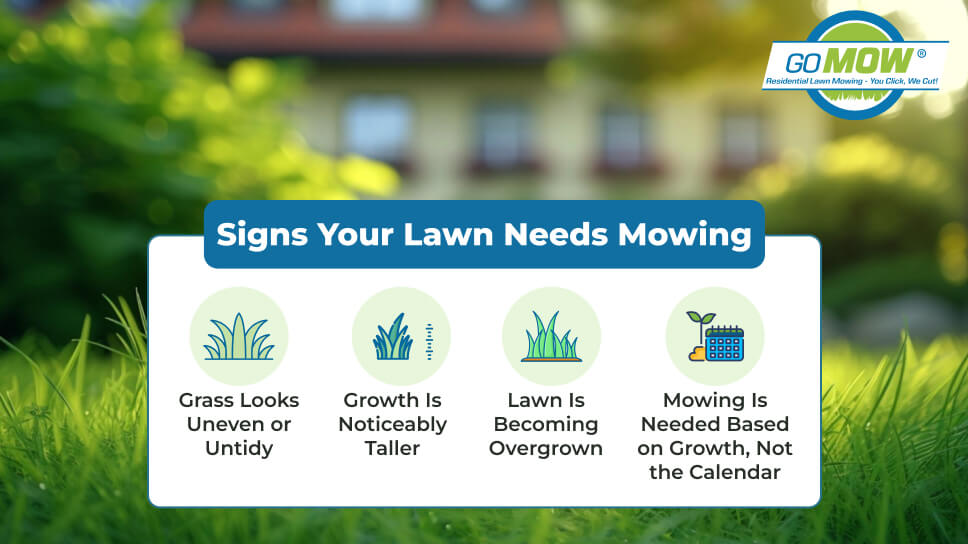

You do not need to measure your grass every time you mow. A few practical signs can tell you when the current schedule is no longer keeping up.
- The grass has become noticeably taller.
- The lawn looks uneven or untidy.
- A significant amount of growth would need to be removed in one cut.
- The lawn is becoming overgrown between scheduled visits.
The point at which a lawn needs mowing can vary with grass type and growing conditions. What matters most is noticing when the grass has grown enough that waiting longer would mean taking off too much at once.
Why Mowing Too Much at Once Can Stress Your Lawn
Letting grass become heavily overgrown and then cutting a large amount in one session is not an ideal mowing routine.
Regular mowing helps keep growth manageable, so you do not have to remove a large portion of the grass at once. This is also why maintaining a reasonable mowing interval is generally preferable to repeatedly allowing the lawn to become overgrown.
The term “scalping” refers to cutting grass excessively short, rather than simply mowing a lawn that has grown somewhat taller than usual. The goal is to avoid unnecessarily aggressive cuts and maintain a routine that matches the lawn’s growth.
What If You Cannot Keep Up With the Mowing Schedule?
Knowing when to mow is one thing. Finding the time to check the lawn and mow it consistently is another.
A busy schedule can make it easy to miss a mowing day. By the time you get back to it, the grass may be noticeably taller and require more work than it would have if it had been maintained regularly.
For homeowners who do not want to monitor grass growth themselves, recurring service from GOMOW Lawn Care Service can provide a dependable way to keep up with routine lawn maintenance.
When Does Recurring Lawn Mowing Make Sense?
Recurring mowing can be useful if you:
- Have limited time for lawn maintenance.
- Do not want to keep checking whether the grass needs mowing.
- Prefer a predictable maintenance routine.
- Frequently find that the lawn becomes overgrown between cuts.
- Would rather have routine mowing handled for you.
It is not necessary for every homeowner. If you have the time and prefer to mow your own lawn, adjusting the schedule as growth changes can work just as well.
Keep Your Schertz Lawn on a Practical Mowing Schedule
The best mowing schedule is not simply a number of days on the calendar. It should reflect how quickly your lawn is growing and how its condition changes with the season, weather, and water it receives.
For many Schertz lawns, that may mean weekly mowing during faster growth and a longer interval when growth slows. If the lawn stays manageable between cuts, your schedule may be working. If it repeatedly becomes overgrown, it may be time to shorten the interval.
If you do not want to monitor growth and adjust your schedule throughout the year, a recurring lawn mowing service in Schertz, TX can handle the routine maintenance for you.
Get started with lawn mowing service in Schertz, TX.
Frequently Asked Questions
Is weekly mowing better than bi-weekly mowing?
Not necessarily. The better schedule depends on how quickly the lawn is growing and whether the grass becomes too tall between cuts.
Can I mow my lawn every two weeks?
Yes, bi-weekly mowing can work for some lawns when growth is slower and the grass remains manageable between visits. It may not be enough during periods of faster growth.
Should I mow more often in summer?
Not automatically. Summer mowing frequency depends on actual grass growth, water availability, weather, and lawn condition.
Does rain mean I need to mow more often?
Rain can encourage grass growth when conditions are suitable, but it does not automatically mean you need to mow every week. Let the lawn's growth guide the schedule.
What happens if I wait too long between mowing?
Grass can become overgrown, which may mean removing a larger amount of growth during one mowing session. Regular mowing helps avoid that situation.


